Convenience & Impulse Retailing Article

Category: Drinks - Cold

Issue: Nov/Dec 2006

Alternative Energy

Can the rising star of the drinks fridge give your bottom line more get-up-and-go than the traditional high performers?

ACNielsen CLOSEUP
Category Market Breakup Energy Drinks $ Millions Growth y/a
MAT Sep 06
Grocery 60.5 28.9%
Major Convenience 90.4 18.4%

The emergence of energy drinks as a powerful player in the convenience store fridge has been so dramatic that many retailers have struggled to keep pace with the public's changing tastes.

But, it seems it's time for retailers to catch up, or to pay the price in lost profit opportunities. Given the nature of the product, it is probably no surprise to learn that energy drinks are not about to run out of steam. Indeed, all the indications are that they are going to continue to give real oomph to drinks sales, perhaps at the expense of traditional favourites such as water and carbonated drinks.

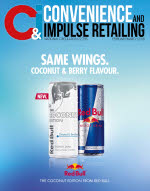
Australia's energy drinks landscape is dominated by two giants of the category, Red Bull and V.

"I think it's time that some C-Store operators took a closer look at a few of the other drinks in their fridge," said Karen Aldridge, Sales Operations Manager for Red Bull, which has a 40% share of energy drink sales in convenience.

Out-of-stocks help no-one

"Energy drinks account for 22% of total drink sales but we find they are under-represented in the fridge and that can lead to out of stock which is obviously not good for anyone.

"We have found that water and soft drinks tend to be over-represented based on sales and obviously that is something we would like to communicate to the retailer. Things are changing so rapidly and energy drinks are growing so fast that it can be difficult to keep up."

The reasons behind the spectacular rise of energy drinks in convenience are not hard to work out. The products tick all of the right boxes for busy people seeking a boost to get them through another frantic day.

"These days, consumers are increasingly time poor and cash rich and are looking for proven products to help them get the most out of their day," said Ms Aldridge. "Red Bull meets their requirements. The primary reason why more consumers are drinking Red Bull is because of its functionality. It helps consumers meet ever-increasing lifestyle demands.
"In addition, Red Bull has a very strong aspirational image that has been created through unique and high levels of investment. This is a point of real difference versus our competitors."
A recent study showed that the highest consumption occasion of Red Bull was when consumers were on their way somewhere, a finding Ms Aldridge says fits perfectly with C-Stores whose customers generally stop into the store while they are out and about.
The same study found the highest consumption of Red Bull was generally in the 15-39 age bracket and was slightly skewed towards males.

"More broadly, the demographics of the main buyers of the category is pretty much anyone in the community who requires energy," Ms Aldridge said. "This includes - but is certainly not limited to - drivers, office workers, shift workers, party goers, young parents and uni students.

"It was found that Red Bull is consumed throughout the day and night, with a higher proportion in the afternoon and evening. It is a good idea for store owners to check their stock levels at this time to avoid potential out of stocks and missed sales opportunities."

Both regular and sugar-free Red Bull is sold in 250ml cans, 330ml bottles and in a four pack of cans.

"The can is the recommended perfect serve of energy," Ms Aldridge said, "while the 330ml is great for consumers who require a little extra energy or to top up their energy levels throughout the day or night.

"These days, consumers are using C-Stores for their top-up shopping and so Red Bull four pack is an excellent incremental sale opportunity. Studies prove that the highest brand sales come from dual ranging of the four pack in both the cooler and on the shelf. The chilled offering encourages up-weighted purchases for immediate consumption - for example, purchasing a four pack to share with others. The warm offering on the shelf is great for the driver on the way home, stopping to do a top-up shop and re-stock the pantry."

Red Bull has been working hard to further lift its public recognition by increasing its involvement in major events such as Formula 1 racing, the Red Bull Air Race and surfing. The strategy seems to be working as a study conducted earlier this year showed 98% awareness of Red Bull in the community.

Red Bull is also lifting its profile with multi-buy promotions, such as the two Red Bull cans for $5, and two Red Bull bottles for $6 deals.

"Our promotions are incredibly successful," Ms Aldridge said. "The sales increase resulting from these promotions are purely incremental and we find that after a promotion is run, baseline sales increase. This is because our promotions increase consumption and bring more consumers into the category."

The company also offers a large range of coolers and point of sale displays to help convenience stores capture incremental sales.

Visibility is the key

"We are obviously keen to work with C-Stores and, depending on their space and sales situation, do what we can to improve sales and profits," Ms Aldridge said.

"Red Bull has made a major investment into various Red Bull coolers designed for particular areas of the store. For example, we have the Bowser cooler which attracts consumers to the store when placed in a highly visible area. There are various counter-top coolers which are perfect to place near the register to capture incremental sales, and small and large open air coolers that enhance the consumer's shopping experience: These can be placed near products that are often purchased with Red Bull - for example, pies and sandwiches, cigarettes and chocolates."

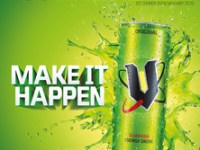
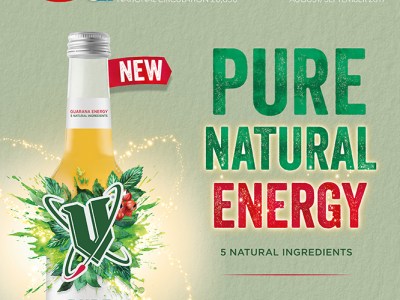
The ‘V' energy drink from Frucor Beverages is the other major player in the Australian energy drinks market. V stands for vitalise and delivers all the pick-me-up qualities of caffeine and guarana in a brand designed for daytime use.

V was launched in 1997 and quickly caught the imagination of a busy generation seeking a boost of energy and vitamins in one swift (non-alcoholic) hit.

Both Red Bull and V are functional products that are well supported by marketing investment. According to the latest ACNielsen data, between them Red Bull and V account for an incredible 94% of total energy sales in the convenience channel.

It's a tough category to break into but the fact that it is growing so quickly means there is no shortage of companies trying to do just that.

Coca-Cola launched Sprite Recharge in June, 2004. The product, which offered the great refreshing taste of Sprite with the added benefit of energy, targeted 16-24 year olds. Sprite Recharge is currently available in route, convenience and food stores and holds a 4.5% market share.

Musashi, which is part of the Nestle group of companies, is another firm that has had considerable success with its energy-focused drinks. These include E Energy, E Shot and Growling Dog Cola.

Functional benefits = success

"These drinks are successful because of the functional benefits they provide to our consumers," said Erol Hassan, Domestic Sales Manager, Nestlé Performance Nutrition. "There is nothing more frustrating than entering an outlet trying to purchase a healthy drink or food product and being confronted with only junk."

Mr Hassan believes the Australian sports drink market, while growing quickly, is still undeveloped and that the product can bring major benefits to convenience store outlets.

"It offers health-conscious, sports-orientated consumers an opportunity to purchase functional and refreshing drinks with a clear benefit to their bodies, making them feel good," he said. "People are more conscious about their snacking occasions and need a healthy alternative."

Better range … better for Convenience

Red Eye is another company that is keen to present the public with some clear alternatives.

"Energy drinks are big and getting bigger, and a better range can only be good for convenience stores," said Theo Kotiadis, Red Eye's Managing Director.

"We are a proven product that tastes good and sells, but it is now very difficult for us to get shelf space in convenience as we are not supported by the huge marketing campaigns of the multi-nationals."

The first bottle of Red Eye, Red Eye Classic, was produced in 1995. Subsequently, a range of five more Red Eye flavours, Gold, Extreme, Passion, Platinum and Power was developed, each with a unique flavour.

Mr Kotiadis acknowledges that convenience is a key channel for products like Red Eye that are targeted firmly at people who are on the go.

"Our customers include people such as truck drivers, nightclub people, people who do extreme sports like surfing, uni students who may be cramming their studies, and night shift workers," he said. "We will be working on strategies to re-establish ourselves in convenience as we can bring variety and different flavours."

Red Eye is currently expanding its portfolio of drinks but says the energy drink Red Eye, with its six flavours will remain absolutely core.

"We have grown some 17 per cent in each of the past six years and we will continue to grow into the future," said Mr Kotiadis.

The vital importance of gaining a foothold in the convenience channel has also been recognised by the Naughty Energy company.

"We are already in independent stores and want to build on that by expanding into convenience," said Matthew Shea, Naughty Energy's Managing Director.

"We are up against the big boys but we still want to expand our distribution. Our point of difference is that we are a functional energy drink that still has those traditional, delicious flavours like cola, orange and raspberry.

"We have also developed some distinctive packaging that has been very well received in the stores. We are really appealing to that younger age group but we have also been surprised about how well received we have been by the mid 30s to 40s demographic.

"The company has been going three years now but with new packaging and new flavours, and the continued growth in the energy drinks market, I think it's going to be a big summer for us."

Another company looking forward to a big summer is Jugular Global Pacific, which has only just begun to sell its Jugular energy drink in Australia.

"Although energy drinks are growing very quickly, it is very difficult to take sales away from the market leaders," said Jugular Director, Tim Xenos. "You can come along with pretty much the same ingredients but you can't hit their market share. We are not going to go into competition, though. Our product is different in that it is not just another energy drink. It has no caffeine, no guarana, just 12gms sugar and low carbs."

Jugular says the product has already received a great response from the general public and sports people alike, and is supported by point of sale displays, fridge wobblers, posters, and other promotional materials.

According to Mr Xenos, the energy boost given by Jugular is not quite as immediate as other energy drinks, but he says the effects last longer.

"This product can bring new people into the category," he said. "C-Store operators can put it on the shelf alongside the market leaders as it is genuinely different. It will definitely attract a younger demographic as it is not as harmful and people can happily drink five or six cans a day if they like. There is no need for a warning about how many cans you can safely drink."

There is then no shortage of energy drinks vying for prized convenience store fridge and shelf space. How they all fare depends to a large extent on how C-Store operators react to the undeniable strength of the category.

The energy drinks market as a whole is currently growing at 21%, faster than any other drink segment that has a significant sales presence. And, looking ahead, more of the same is forecast. Specialist food and drink consultant, Zenith International, predicts double-digit growth in energy drinks until at least 2009.

But will energy drinks gain a larger share of fridge space, as the market leaders would like? And will the smaller energy drinks manufacturers manage to gain some sort of foothold in convenience?

As ever, the C-Store fridge will be a very interesting place to keep an eye on over the coming months and years. Competition has never been fiercer.